Color wheel, attempt 3

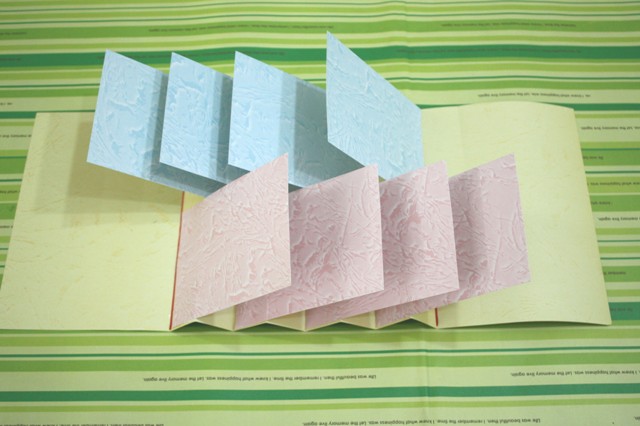
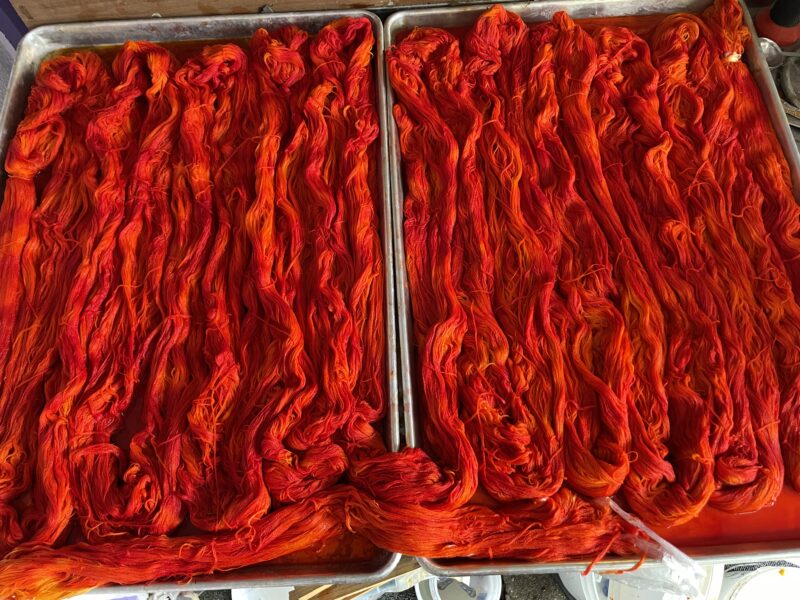
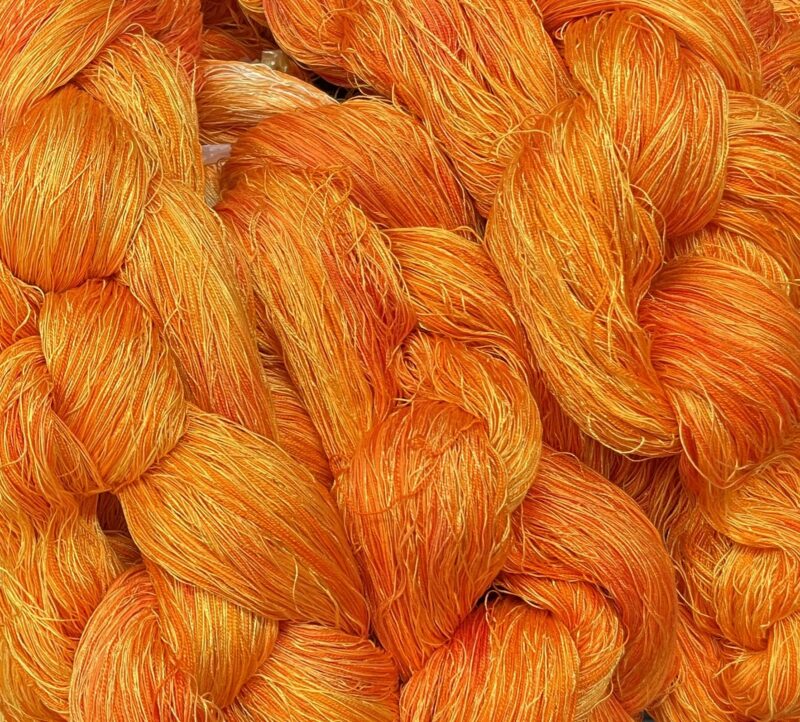
I finished the next set of attempts for the color wheel.  Here are the photos and my notes (note that the photo is very untrue to color, for reasons noted below – it’s more to give a general idea of what’s going on than an actual sense for the matches):

3rd attempt at dyeing a color wheel using Lanaset dyes

3rd attempt at dyeing a color wheel using Lanaset dyes

I am still finding it difficult to assess near-matches because of the glossiness of the silk and the way the hue-value-chroma changes (often radically) depending on the angle of the light.  I am trying to do the matching at approximately the same time of day (7:30am or so) in the same place, viewing a flat horizontal surface from above.  But it is still difficult.  I look at the photo above – green does not look like a match at all because the light is coming from a slightly oblique angle, but viewed from straight above it matches perfectly.  And so on.

I also decided to remove the color chips and place them on the card.  The edge of the card has shadows that make assessing the match more difficult.

Here are my notes from the comparison (click to get the larger image so you can actually read it!)

notes from 3rd attempt at color wheel

notes from 3rd attempt at color wheel

The last assignment is to pick a color, any color, and try to reproduce it.  I will pick a (relatively) neutral color since that is more challenging, and I want to do the hard stuff within the context of the study group while I can still get the thoughts of Karren and the other study group members.  (And, you learn more by diving into the hard stuff first!)

Regarding my taquete puzzle, I did what I should have done at the beginning and called Sharon, my sewing mentor, to ask her about lining a shawl.  It turns out it’s quite do-able – all you have to do is do an invisible, loosely-sewn tack about once every 10-12″ within the shawl, to keep the layers together.  So it’s full steam ahead!  I have purchased several thousand yards of rayon embroidery thread to do the weaving, and it won’t be here for several days, so I’m going to use the interim time to (a) further refine the peacock feather pattern, and (b) maybe weave up some butterflies.  For some reason, I really like the idea of weaving butterflies!

Also posted in dyeing, textiles | Tagged , , | 4 Comments

Peacock feathers, round 2

I changed the original design for the peacock feathers to include more solid black between the feathery parts.  Here’s how it came out (look at the bottom row for the best view, as the top row still has the top part of the previous version):

handwoven peacock feathers, round 2

handwoven peacock feathers, round 2

Contrast this with Round 1:

handwoven peacock feather design, in five-weft taquete

handwoven peacock feather design, in five-weft taquete

The new version looks much better, more feathery and less blobby.

Lillian (thanks Lillian!) made an excellent point when she said that the back side would not be the reverse of the front side, hence (possibly) not suitable for a shawl.  (I am pretty sure the drape will be OK, as the four-weft taquete came out very fluid.)  I’m still turning over various possibilities for lining the shawl – the main problem being how to attach the two fabrics together without losing the drape or spending 40 hours catchstitching them together – but it seems unlikely to succeed, at least for now.

(Those of you jumping up and down, waving your hands excitedly, and saying, “Stitched double weave!” are quite correct – that would give me one layer of plainweave to hide the bottom layer of the taquete, and I could then decorate the plainweave, if desired, using surface design techniques.  The only small problem is that I’d have to resley at double the sett, since it is a doubleweave, which in turn means re-beaming, re-threading, re-sleying, oh, heck, just do a different warp.  (Not to mention, six shuttles!)  So, I may try this at some point, but not on this warp.)

This leaves me the interesting question of what to do with the fabric.  The pattern is really too assertive (and too large) to use in clothing, and taquete is too delicate to use in something like cushions.  A wall hanging it’s not.  So it’s hard to think of what to do with the fabric, except decorative stuff like Christmas cards, and I’m not sure where peacock feathers fit into Christmas cards.  I feel like I’m all dressed up with no place to go!

While I’m pondering this quandary, I received a cross-stitch sampler book in the mail yesterday.  Someone (I’m afraid I don’t remember who) suggested to me that cross-stitch samplers are a great place to get design motifs, because the individual components of the sampler are so small.  Indeed ’tis so, so I will probably weave up some butterflies (suitably adapted for taquete) and other small figures over the next few days as I contemplate what to do with my taquete fabric.

Meanwhile, I have just finished dyeing another set of samples, so look for Color Wheel #3 sometime soon…

Also posted in textiles, weaving | Tagged , | 3 Comments

Peacock feathers

I spent part of yesterday browsing through the drafts on Handweaving.net, looking for inspiration.  One of the drafts looked a little like peacock feathers, and that struck me as a fruitful subject: it would turn one of the disadvantages of multiweft taquete, the fact that the colors on the bottom show through, into a major plus.  Peacock feathers are iridescent! so having small glints of the other colors showing would be perfect.

So I looked at a bunch of peacock feather images, took one, resized it, indexed the color, and then did a LOT of editing in Photoshop to produce this result:

Photoshop simulation of peacock feather design

Photoshop simulation of peacock feather design

It has seven shades: black, dark green (green + black), light green, bronze, turquoise, purple, and dark purple (purple + black).  As much as I wanted a four-shuttle weave, I just couldn’t reduce to four weft colors without losing something important.  So this is a five shuttle weave.

Then I did the extensive manipulations necessary to produce a weavable file, producing this drawdown:

peacock feather drawdown

peacock feather drawdown

And then, of course, I wove it up:

handwoven peacock feather design, in five-weft taquete

handwoven peacock feather design, in five-weft taquete

I like it, tentatively, though I will probably modify the design to eliminate the dark green.  There is very little visible difference between the dark green and the light green (I should have remembered this), so my intended feathery effect turned into a green blob.  I will instead make the black go further into the green sections, producing the desired feathery effect.

Is this not a miracle of modern software?  From idea to simulation to drawdown to woven fabric, all in just one day.

As a five-shuttle weave, it is quite slow.  So far it is coming out at 90 ppi, and about 4.8 seconds/pick, so it looks like I can weave just about 8″ per hour.  Again, time-consuming but not insurmountable – that’s 10 hours of weaving to do an 80″ shawl, about a week of work.

Next up: experiment with some variations.  I want to simulate it with thin purple stripes lengthwise between the feathers, and change the design so the feather edges are “feathered” with black rather than green/black.  I also want to experiment with using a strand of glitter either in the blue or  the purple, though I think that is probably gilding the lily.

If I like the results from that, it will be time to weave up the shawl!

Also posted in textiles, weaving | Tagged , | 2 Comments

Color wheel, attempt #2

Peg asked whether it was difficult to determine the match when dealing with a glossy yarn “chip”.  It is extremely difficult, because the hue and value change markedly depending on the angle of the yarn to the light and to the viewer.  I finally settled on using diffuse daylight with the book flat in front of me; it was the only way to keep my sanity.  According to Karren, industry uses light boxes for this purpose.  I may try this; I have a makeshift “light box” for photography anyway, so could bring it out for use in color matching.

At any rate, here is my “color wheel”, minus the RP card, which I didn’t have time to wind.  I am still tweaking the colors on most of these:

Color wheel, dyed using Lanaset dyes

Color wheel, dyed using Lanaset dyes

The red is a little too blue, the orange definitely too yellow.  Yellow has too high chroma and needs to be toned down, probably by adding black.  Yellow-green is problematic: it is ALMOST a match, the hue (color) and value (lightness/darkness) are correct but it has slightly too low chroma (saturation).  This is difficult to fix, but I think I might be able to manage it.

Green is too yellow – more turquoise is needed.  Blue-green and “blue” (what you are probably seeing as turquoise) are spot on.  The royal blue chip is almost correct, but the chroma is too high (the color is too “bright”); next time I’ll add some black to tone it down.  The violet is way off; it needs more red, but I don’t think I can get it correct with the dyes I used, so I’m going to try a different combination of dyes.

It is amazing how subtle the color differences can be, and how challenging they are to “fix”!  I have been keeping notes on each batch, with comments about the direction in which I’m trying to nudge the colors.  I think it will take me at least another 2-3 batches of skeins before I get things right.

After that, of course, it’s on to the Cibacron F color wheel…

Next (and final) exercise after that is picking a specific color to reproduce.  I will probably pick a neutral color (beiges and browns), as Karren says they are the hardest to reproduce.  I figure I might as well try the most challenging color possible during the study group – that way I can get help on it if I need it, which won’t be the case afterwards.

I am very pleased with what I am learning in this study group, it’s taught me huge amounts about dyes and dyeing.  If Karren ever offers this class commercially, it will be well worth taking.

Also posted in dyeing, textiles | Tagged , | 1 Comment

Finished handwoven taquete samples

Yesterday I wove up the rest of the bookmark.  I also had the delight of discovering eight partial cones of cashmere yarn from Colourmart on my doorstep when I returned from shopping!  If you aren’t familiar with Colourmart, they specialize in remainders from the top Italian (etc.) mills – you can get top-quality cashmere, silk, merino, and occasionally alpaca, mohair, and even vicuna yarns from them at less than 50% of retail.  If you order large quantities, sometimes you can get discounts even on their already-discounted prices.

Anyway, I had written Richard and his happy crew asking if I could have some of his “odds ‘n ends” from the 2/72 nm and 2/46 nm.  So I got eight partial cones, four of each weight, all in different colors.

And I wove up this rendition of the chrysanthemum, using the 2/72 nm cashmere:

handwoven taquete, cashmere chrysanthemums

handwoven taquete, cashmere chrysanthemums

Much more subtle than the versions woven in brighter colors:

japanese crests, handwoven taquete

japanese crests, handwoven taquete

The first two crests are woven in rayon machine embroidery thread, the third (top) one is woven in a tencel/silk mix at 12,000 yards per pound.  You can see that the machine embroidery thread, while beautiful, is a little too fine: the crest, which is supposed to come out circular, is more of a flattened oval.  The tencel/silk mix, on the other hand, is too thick, stretching the circle into a long ellipse.  The 2/72 cashmere is almost precisely correct, only slightly flattened.  I have the feeling that 60/2 silk would be just perfect.

And here are the bookmarks:

handwoven taquete bookmarks, front

handwoven taquete bookmarks, front

handwoven taquete bookmarks, back

handwoven taquete bookmarks, back

I rather like the back; it doesn’t have the high contrast between puzzle pieces and background, but it has a cheery colorfulness that appeals to me.  But then, I like color.

The drape of the taquete pieces is very supple, and it has enough body to make a decorative shawl.  The cashmere is, as expected, super soft.  I’m pretty sure I won’t weave up the 2/72 nm cashmere into a shawl, but I’m wondering whether the 2/46 nm cashmere would work.  I think it is likely too thick, but it comes in lots of fairly bright colors, so is more appealing as a choice.  Silk might work out better, especially since I have loads of silk.  I’m also negotiating for some white silk tram (a VERY loosely twisted reeled silk) and may get some in a few weeks.  The stuff isn’t very durable (tends to fuzz) but it is very pretty, maybe good for a decorative shawl that doesn’t get worn all the time.

Anyway, I am pleased with my first taquete samples – now I’m just groping for a design that catches my fancy sufficiently to weave up some yardage!  I am getting the hang of weaving with four shuttles, so am working at about double or even triple my initial speed – I’m guessing about 8″ per hour.  That is still fairly slow – a 72″ shawl would take me about 9 hours of weaving time – but by no means impossible.  I think I could do it in about a week.

Dye-wise, I have a bit of a conundrum.  I have finished my second batch of samples, but I am suffering from what I suspect may be a little bit of RSI (repetitive stress injury, for the curious) in my left arm.  As a result, I’m trying to avoid doing things with my left arm, which makes winding the cards difficult.  At the same time, I really really really want to see how close my new samples are, so I do want to wind at least a couple of cards.  I think I may approach it in five or ten minute chunks, with frequent breaks, and quit if I start having any discomfort whatsoever.  RSI is nothing to be trifled with – I have friends who have literally had to quit their jobs because of it.  And while I’m not as high-risk as, say, a software engineer, I still do a lot of typing in my profession.  So I am trying to take things easy.

Also posted in textiles, weaving | Tagged , | 1 Comment
  • Loading
  • Join the Weavolution!

    Weavolution
  • Blog Posts

  • Travel Blog Posts

  • Archives

  • Tags

  • My Favorite Websites

  • WeaveRing

  •