Sadly, I’m a much better artist than photographer, so the pictures are less than perfect. Click the images for a larger version, or come by sometime and see them in person!
I make these eggs using traditional Ukranian techniques, drawing on the egg with melted wax and then dipping it into a series of dyebaths. Most eggs require at least four or five different dyes, and some have been dyed seven or eight times.
I start by roughing in the design in water-erase fabric pen. This allows me to “erase” any mistakes with a wet Q-tip (pencil marks are difficult to remove on eggs). Then I make a more detailed design in pencil, erase any leftover marker, and begin applying wax to areas that will remain white. I dip the egg into a yellow dyebath, apply wax to the areas that will remain yellow, and so on until all the colors have been applied.
Making these eggs poses some interesting technical challenges. The aniline dyes used for the eggs react with each other–for example, orange will strip away all other colors, and blue and pink give different colors when dyed over each other. Some colors are mutually exclusive–for example, once you have dyed the egg blue, you can no longer get yellow, and vice versa. I’ve done quite a bit of experimenting and chemistry reading to get the results I want, and am still discovering new things.
Lately I’ve been playing with crossing in some new techniques–calligraphy, gilding, and precious gems. Someday soon I hope to try cloisonne (enamel). It’s a small craft, but endlessly fascinating.

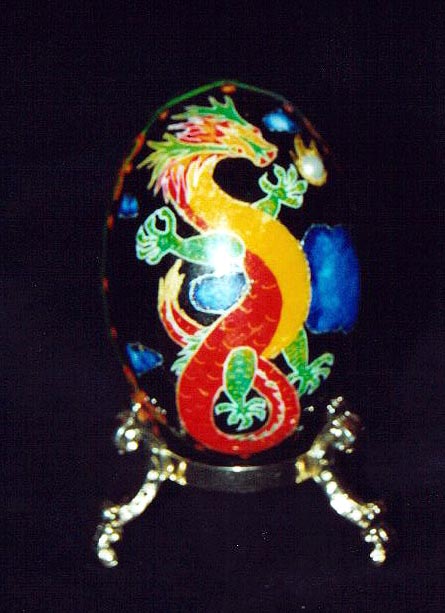 This combines quite a few techniques. The dragon is holding a flaming pearl--the flames are 23kt gold leaf, and the pearl is real (cultured button pearl). The dragon is outlined in gold (clear gutta mixed with iridescent gold dust), the clouds are limned in silver, and the red stripes on the dragon's belly are drawn in with a calligraphy pen. Because blue and yellow are incompatible colors, I had to bleach the clouds before re-dyeing. Since bleach destroys dye uptake (it chops the surface proteins into tiny little pieces), I applied a little wood glue to the clouds to encourage dye uptake. (Wood glue, being protein-based, dyes very nicely.)
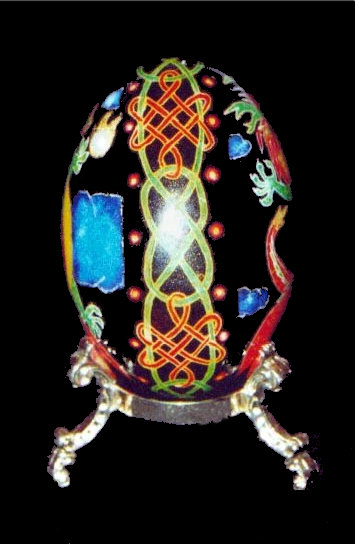 A side view of the same egg.
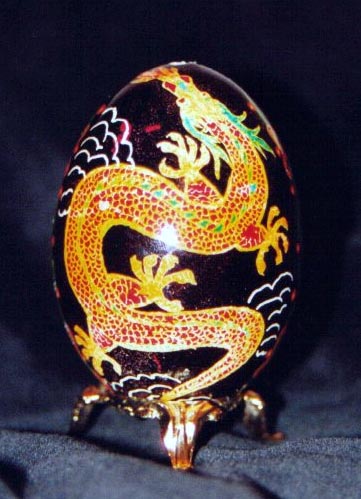 I made this one on the way to the dragon pictured above. It's neat how the altered perspective produces a totally different visual focus...
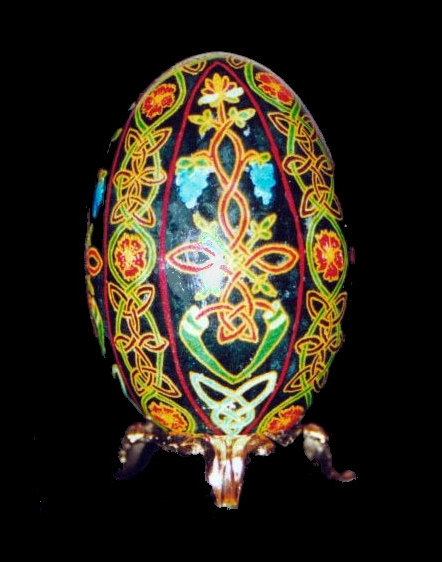
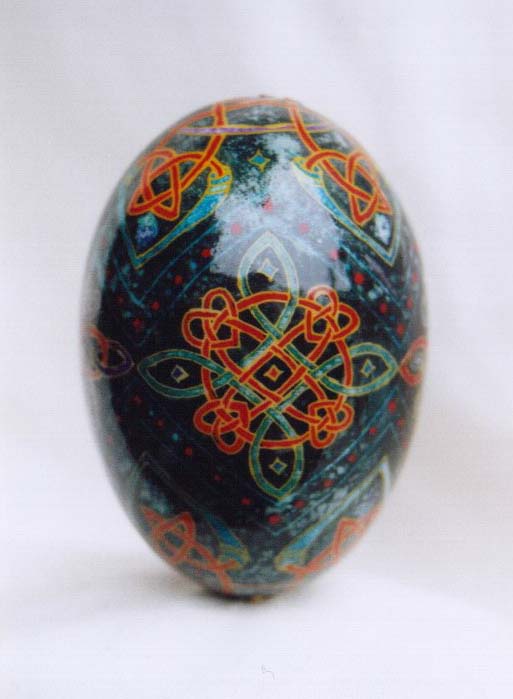 Here I was experimenting with Celtic knot variations and bleach work. If you click on the icons, you can see the mottled/"antiqued" look in the blue/black areas. Bleach destroys the proteins in irregular patches--used exactly right, it produces a lovely mottling. Of course, the challenge is knowing when to stop...I had to paint some areas in egg white to improve dye takeup.


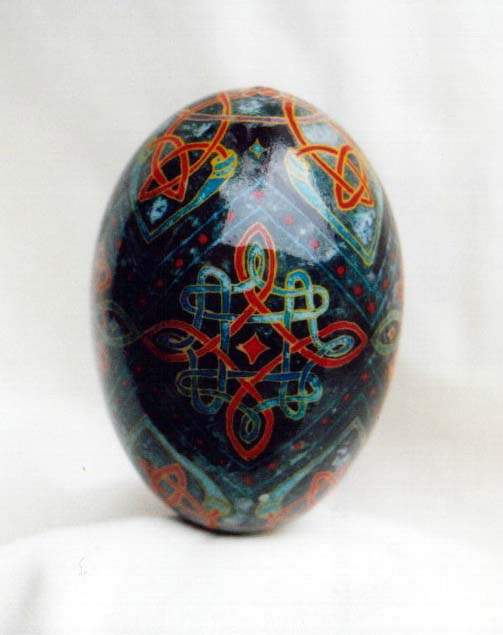
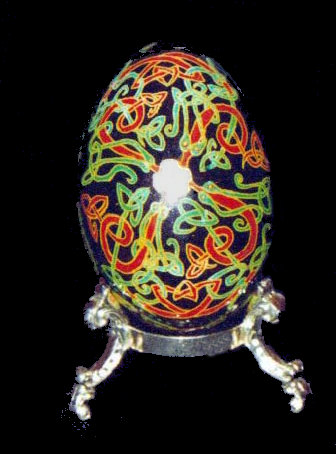
 You gotta zoom in on this one to appreciate it. This was my experiment in ultrafine-tip tools--all the lines on this egg are less than .2 mm wide. It's also one of my first Celtic knotwork pieces.
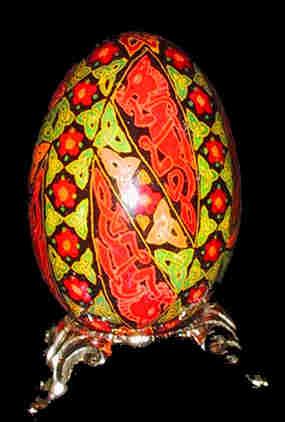 A side view of the same egg.
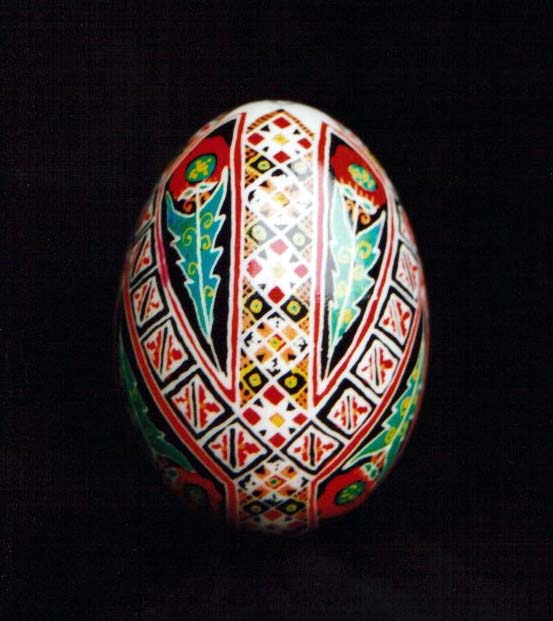
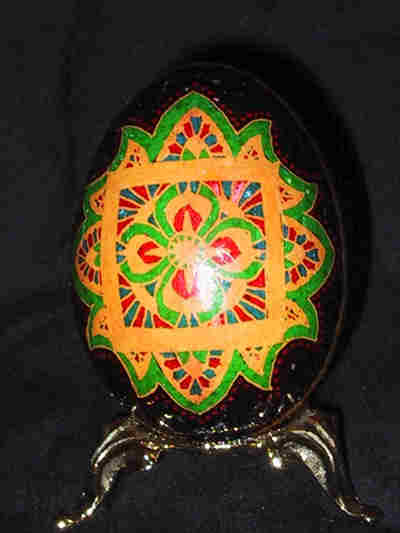 An experiment in abstract patterns. Like my other pieces, this is done on a jumbo duck egg, resulting in glowing jewel colors. Chicken eggs are more opaque; they are also pebblier, making it hard to draw very fine lines. I find duck eggs give a nicer depth of color.
